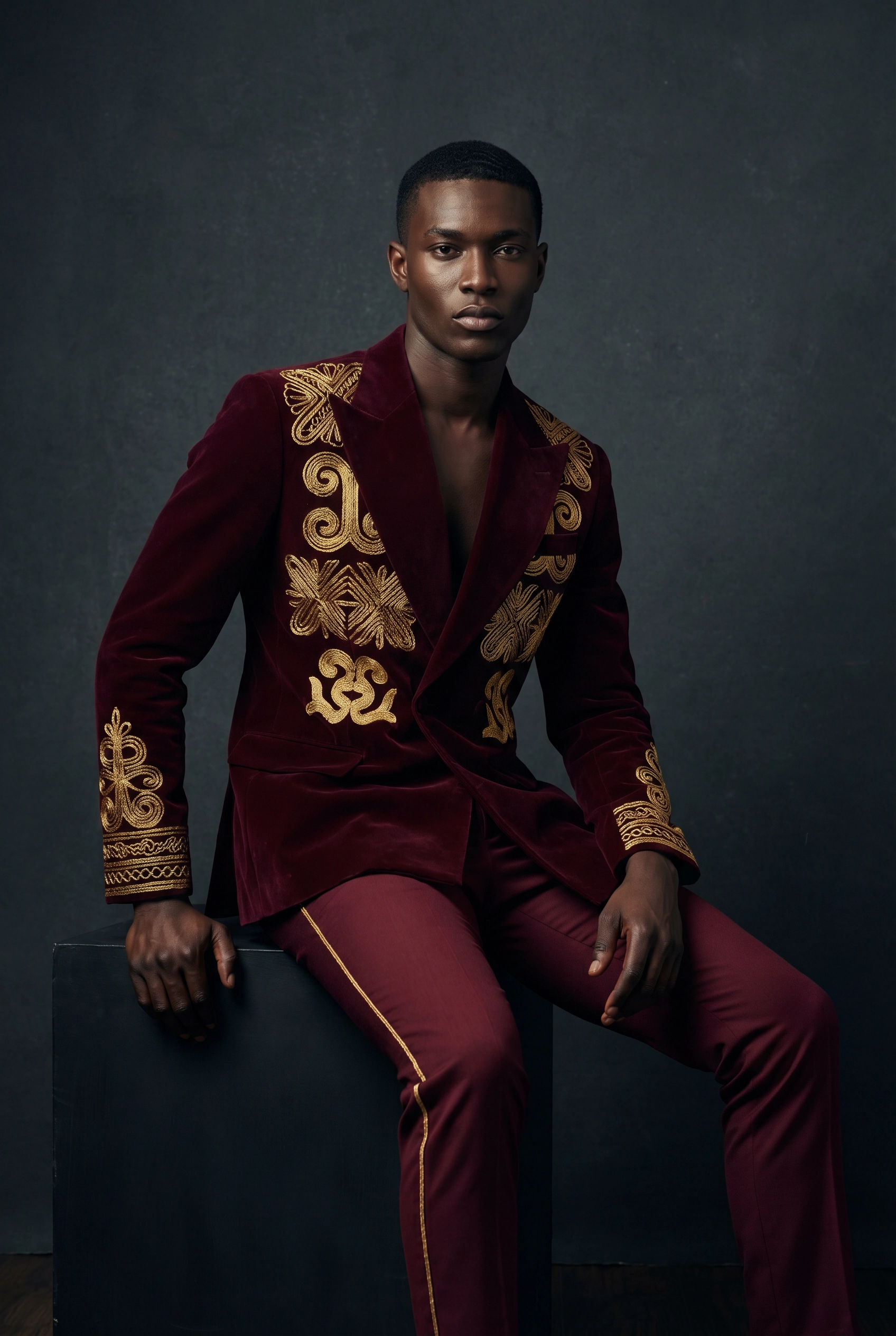
Kwame: The Accra Kente Master Who Weaves Memory into Cloth
In his Osu atelier, surrounded by hand-loomed kente in gold, crimson, and forest green, Kwame creates contemporary ceremonial menswear for the diaspora man who wants to honour his heritage without feeling costumed.
Kwame does not simply make clothes. He weaves memory.
In his Accra atelier — a sun-drenched studio in the Osu neighbourhood, where bolts of hand-loomed kente are stacked from floor to ceiling in columns of gold, crimson, and forest green — Kwame speaks about his craft the way a historian speaks about an archive. Every strip of kente, he explains, is a sentence. Every pattern, a word. And every garment he creates for a diaspora client is a letter written home.
"When a man in Toronto or Houston or London wears kente to his son's naming ceremony," he says, smoothing a length of Ashanti Adweneasa cloth across his cutting table, "he is not just wearing fabric. He is saying: I remember. I belong. I carry this forward."
The Language of Kente
Kwame grew up in Kumasi, the spiritual home of kente weaving, where the sound of the narrow-band loom — a rhythmic clack-clack-clack that fills the air of the Bonwire village — was as familiar as birdsong. His grandfather was a master weaver who supplied cloth to the Kwamehene's court. His mother ran a tailoring shop that dressed three generations of the same families for every rite of passage: outdoorings, engagements, funerals, graduations.
"I was surrounded by the idea that clothing is ceremony," he says. "Not fashion. Ceremony."
He studied at the Kumasi Technical University before moving to Accra, where he spent five years apprenticing under one of Ghana's most respected menswear tailors before opening his own studio at twenty-eight. Today, at thirty-four, Kwame's work has been worn at weddings in Atlanta, naming ceremonies in Amsterdam, and chieftaincy installations in Accra itself.
Dressing the Diaspora Man
What sets Kwame apart is his understanding of a particular kind of client: the African man in the diaspora who wants to honour his heritage without feeling costumed. The man who wants to walk into a church hall in Birmingham or a banquet room in Houston and feel both rooted and modern.
"The diaspora man has a complicated relationship with traditional dress," Kwame says. "He loves it. He is proud of it. But he is also afraid of getting it wrong — of wearing something that doesn't fit his body, or that reads as costume rather than culture."
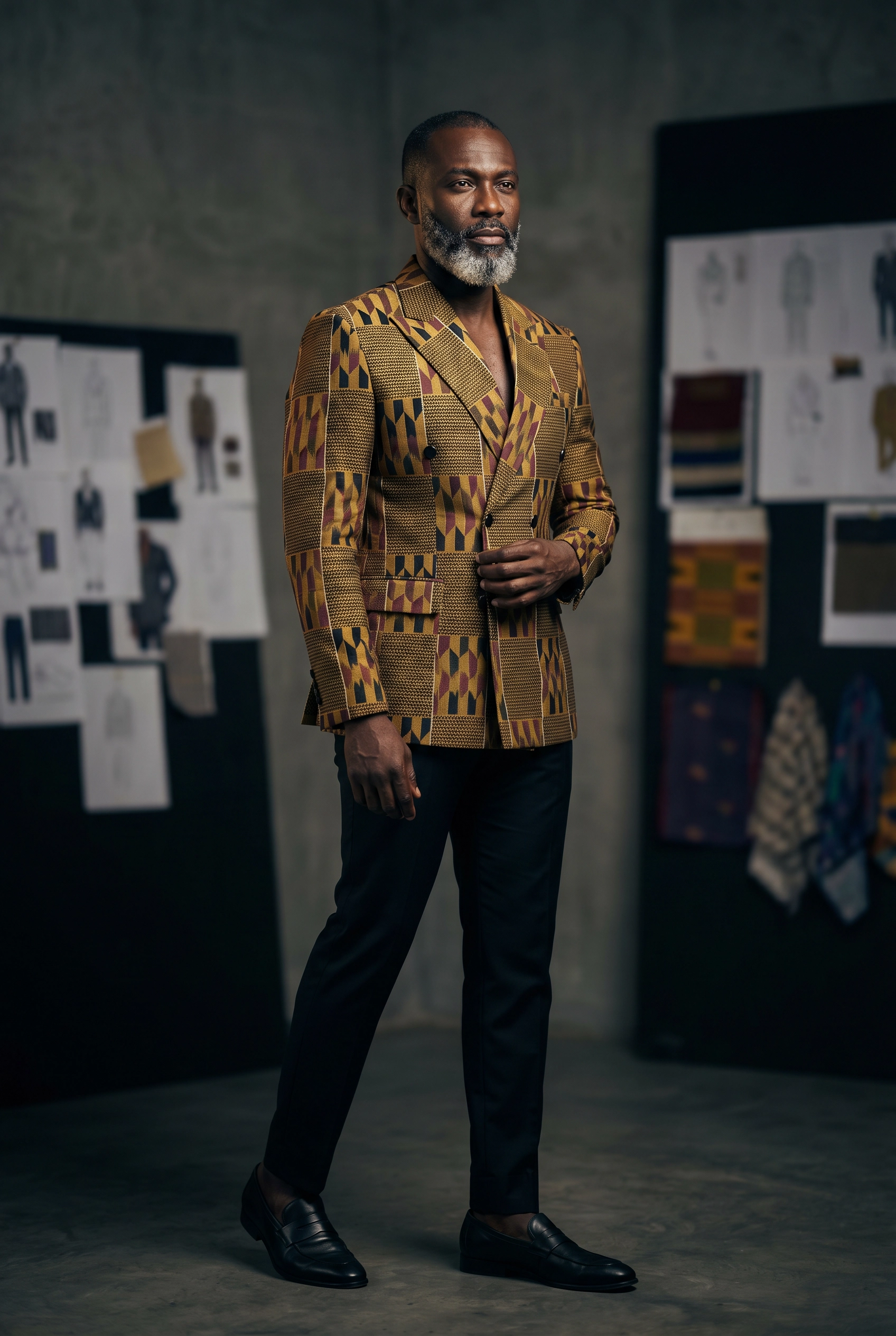
Kwame's solution is what he calls contemporary ceremonial — garments that are unmistakably Ghanaian in their use of kente, but cut and constructed with the precision of European tailoring. A slim-fit suit with kente lapels and cuffs. A modern agbada with a structured shoulder and a shorter hem. A toga-style kente draped over a linen base that reads as both traditional and effortlessly stylish.
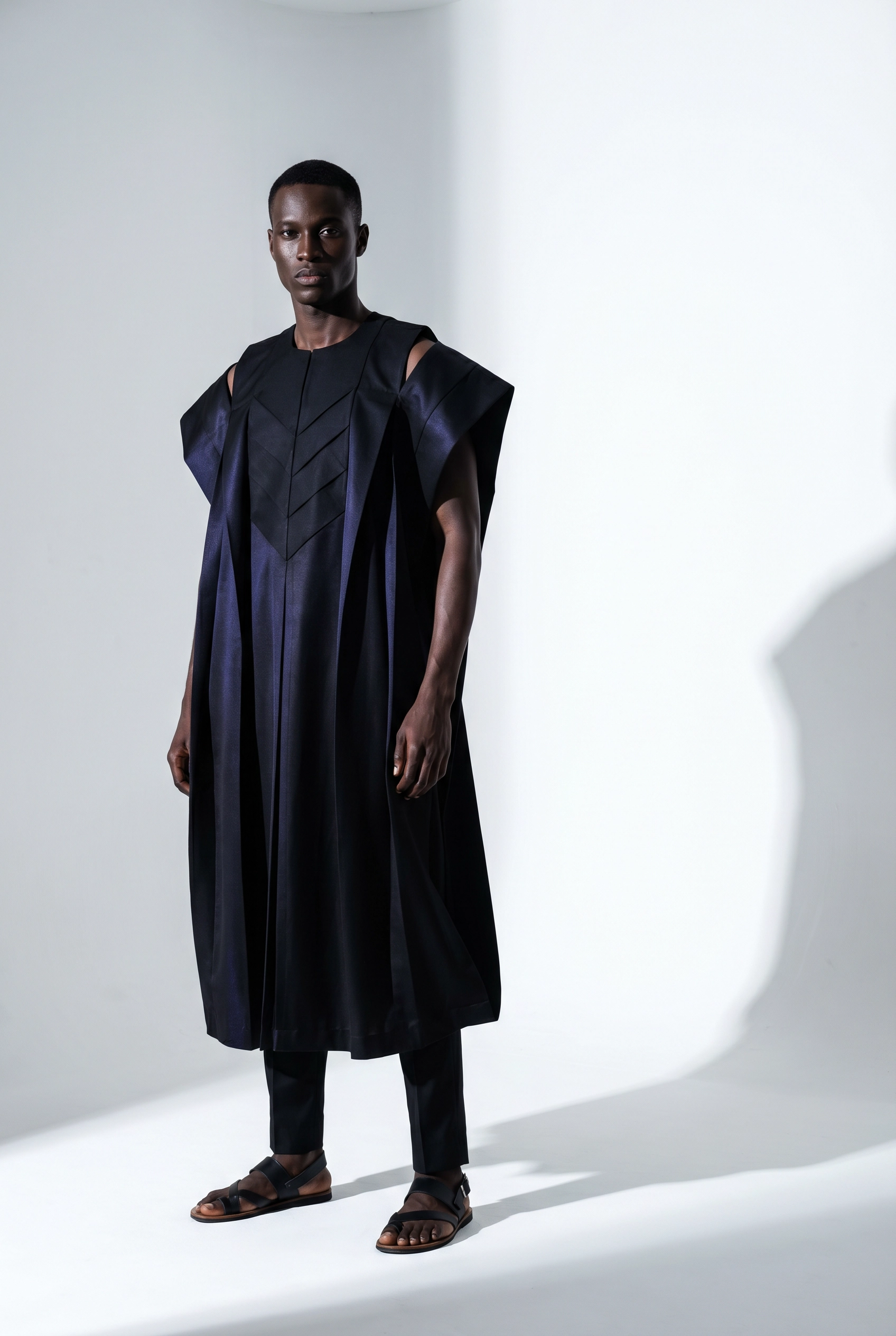
"The fabric does the cultural work," he explains. "My job is to make sure the silhouette does the modern work. The two things should not fight each other. They should be in conversation."
The Commission Process
Every Kwame commission begins with a conversation about the occasion. Not just the event — the meaning of the event. Is this a first son's naming ceremony? A father's funeral? A wedding where the groom wants to honour both his Ghanaian heritage and his British upbringing?
"I need to understand what the garment is for before I can understand what it should look like," he says. "The cloth I choose for a funeral is different from the cloth I choose for a wedding. The patterns mean different things. The colours carry different weight."
For diaspora clients, Kwame works primarily through video consultation — a process he has refined over four years of dressing clients he has never met in person. He asks them to send photos of the venue, the family colours if there is an aso-ebi coordination, and — crucially — photos of themselves in clothes they love.
"I need to understand how a man carries himself," he says. "Some men are comfortable in volume. Some men want to be invisible in a crowd and let the fabric speak. I design for the person, not just the occasion."
Kente as Heritage, Not Costume
One of the questions Kwame is asked most often by diaspora clients is whether it is appropriate for them to wear kente if they are not Ghanaian — if they are Nigerian, Kenyan, or Jamaican with Ghanaian roots.
His answer is characteristically thoughtful. "Kente belongs to the Akan people of Ghana. It has specific meanings and protocols. I always explain those meanings to my clients, because I believe that wearing something with knowledge is an act of respect. Wearing it without knowledge is where it becomes costume."
For non-Ghanaian clients who want to incorporate kente into their celebration wear, Kwame offers what he calls kente-inspired pieces — garments that use the geometric vocabulary of kente weaving without appropriating the specific royal and ceremonial cloths that carry deep cultural significance.
"There is a difference between inspiration and appropriation," he says. "I am happy to help anyone find the right side of that line."
What Yasoké Means to Him
Kwame heard about Yasoké through a fellow designer in Lagos. He applied to be a founding designer within twenty-four hours.
"The problem Yasoké is solving is real," he says. "I have lost clients because they could not figure out how to pay me safely from abroad. I have had garments arrive damaged because the shipping was not handled properly. I have had clients who trusted me completely but had no way to verify that trust to their families, who were worried about sending money overseas."
He pauses, running his hand over a length of crimson and gold Bonwire kente. "What I make is not cheap. It is not fast fashion. It is a piece of heritage that a family will keep for generations. It deserves a platform that treats it with that kind of seriousness."
He looks up. "Yasoké is that platform. I am proud to be part of building it."
Kwame is based in Accra, Ghana. He specialises in contemporary ceremonial menswear using authentic hand-loomed kente cloth. He is one of Yasoké's founding designers.